
Creating a Template
Slack Templates
Create and manage Slack templates in Fyno using text or Block Kit JSON, with threading, placeholders, user tagging, testing, versioning, and approval workflows.
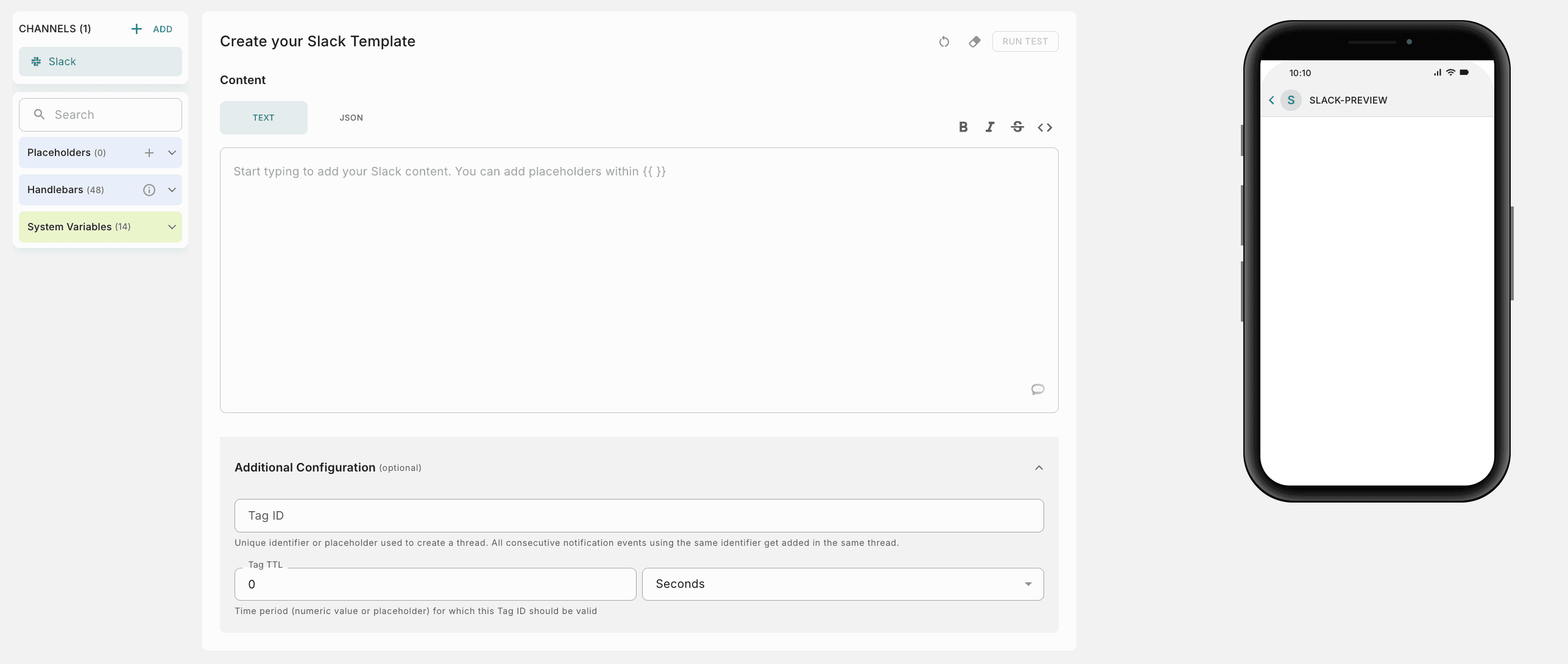
When you add the Slack channel to a template, the Create your Slack Template screen opens. The Preview on the right shows how the message looks in Slack.
Add the content
Under Content, choose how you want to write the message body.
Use Text to send a simple message. Type your message and use the toolbar above the field for bold, italic, strikethrough and code formatting. You can add placeholders within {{ }}.
Additional Configuration (optional)
Expand Additional Configuration to group related notifications into a Slack thread.
| Field | What it does |
|---|---|
| Tag ID | A unique identifier or placeholder used to create a thread. All consecutive notification events that use the same identifier are added to the same thread. |
| Tag TTL | The time period (a numeric value or a placeholder) for which this Tag ID is valid. Enter the value in the first field, and select Seconds, Minutes, Hours or Days in the second. |
Placeholders
Below the Channels section on the left, you can find placeholders. Placeholders are denoted by {{ }} or Handlebars. Click a placeholder to open a pop-up window where you can define its parameters. See the comprehensive guide on Handlebars.
Did you know?
You can use a period (.), underscore (_) or hyphen (-) within the handlebars. Try it now!
You cannot use only numeric values as placeholder keys.
How to tag users and channels
Use these in your message content:
| Syntax | Who it notifies |
|---|---|
<!here> | Only the active members of a channel. |
<!channel> | All members of a channel, active or not. |
<!everyone> | Every person in the #general channel, which is every non-guest member of the workspace. |
<@abc.xyz> | A specific user. For example, use <@abc.xyz> to tag the user with the email abc.xyz@gmail.com. |
How to add dynamic content
You can add dynamic content to your templates using one of the four options below:
How to test a Slack template
Use this feature to test a template thoroughly before including it in any Notification Event. This ensures early detection and resolution of any potential issues, for a seamless user experience.
Click Run Test at the top right of the template. The test pop-up opens.
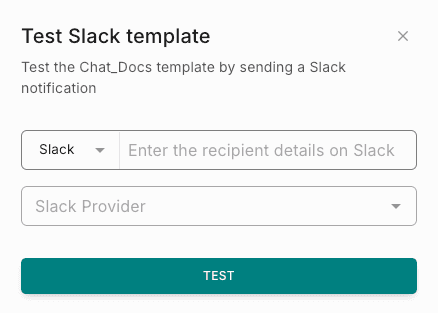
Enter the Slack recipient, or a distinct_id. Make sure to enter the distinct_id of a Test User profile.
- To send a direct message, use
@name. - To send a message to a channel, use
#channel_name. Make sure the Slack app you created is added to that channel.
Select a Slack integration that is already configured in Fyno.
Click Test to send the message to the recipient with the selected integration. You see the success or failure message along with a link to the Sent Logs.
Save and go live
Click Save to save the template as a Test version. You can save different versions of the template this way. Use Go Live when you are ready to move your template to the Live version.
If your workspace has a maker-checker workflow enabled for template management, Go Live needs an additional approval step. Choose from your designated approvers, who review and authorize the template changes. See Approval flow for the steps.